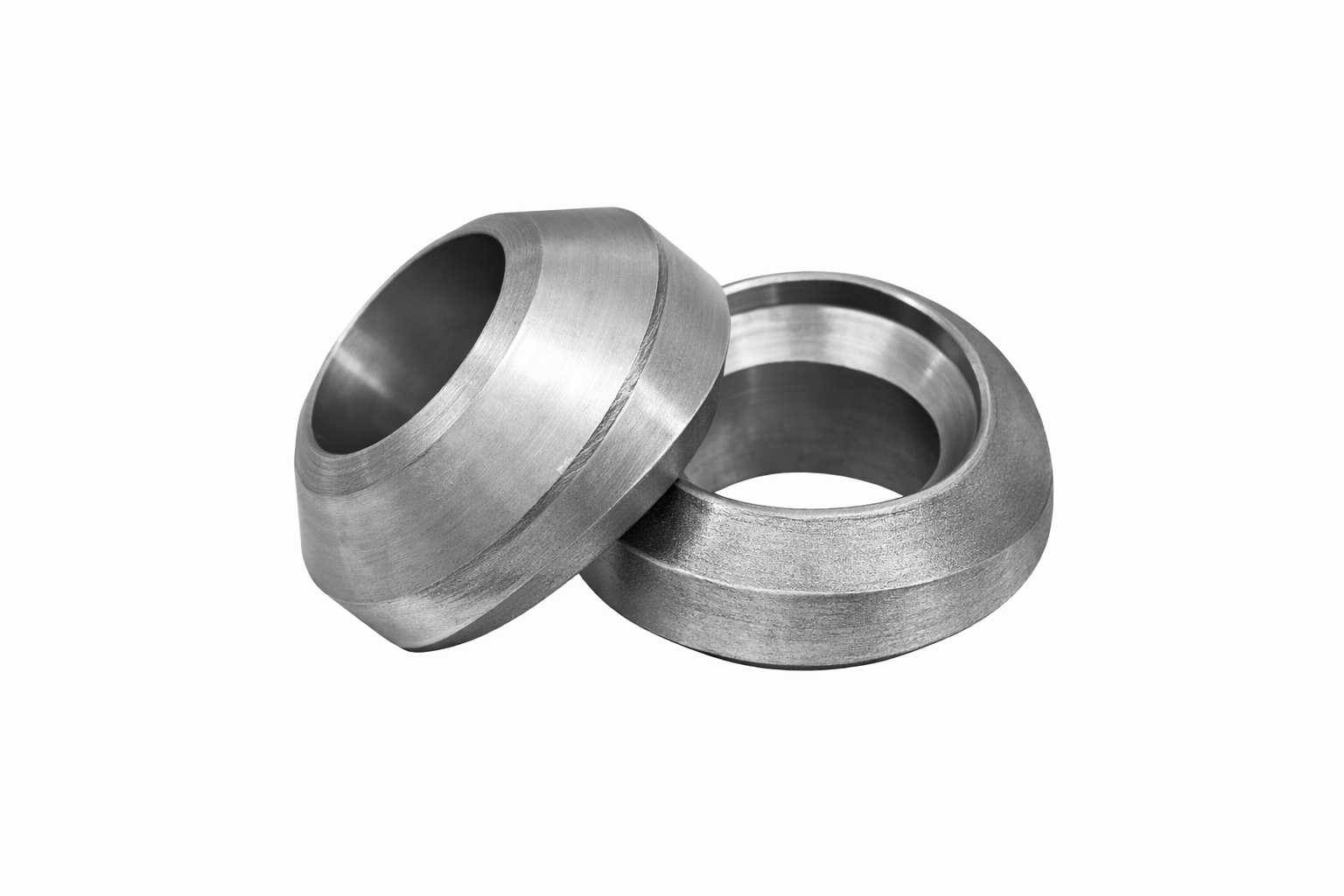
Manufacturer & Exporter of Forged Fittings — Threaded Fittings | Socket Weld Fittings | Branch Outlets
Self-reinforcing forged butt-weld branch outlet in Stainless Steel 304/316, Duplex Steel and Super Duplex Steel — manufactured per MSS SP-97 in Standard, XH and XXH schedules.
The Weldolet is an integrally forged, self-reinforcing branch connection fitting used to create a butt-weld branch outlet on a larger diameter run pipe. The fitting is welded directly onto the run pipe over a cut hole equal to the branch bore, eliminating the need for a separate reinforcing pad. The branch pipe is then butt-welded to the Weldolet outlet using a full-penetration groove weld, creating a complete, fully welded branch assembly that is stronger and more leak-resistant than set-on branch connections or pad-reinforced tees.
The Weldolet is the preferred branch connection method in oil & gas, petrochemical and power generation piping systems operating at high pressure and temperature, where the full penetration weld to the run pipe and the self-reinforcing forged body together provide the required pressure integrity without the stress concentration associated with un-reinforced fabricated branch connections.
Cunimet Alloy International manufactures Weldolets in all standard run-to-branch size combinations per MSS SP-97 in Standard (Std), Extra Heavy (XH) and Double Extra Heavy (XXH) wall schedules. The contoured base is machined to match the run pipe OD for each run size, ensuring full contact and a consistent, gap-free weld preparation before assembly.
“H” = Height of the Weldolet from the run pipe contact surface to the top face of the butt-weld outlet. Bevel preparation per ASME B16.25. Dimensions shown are for the branch outlet; run pipe size determines the base curve radius. All dimensions in millimetres.
| Branch NPS | Branch Pipe O.D. (mm) | Height “H” (mm) | End Prep | Bevel Standard | ||
|---|---|---|---|---|---|---|
| Standard (Std) | Extra Heavy (XH) | Double XH (XXH) | ||||
| 1/2" | 21.3 | 38 | 44 | 51 | Butt Weld (BW) | ASME B16.25 |
| 3/4" | 26.7 | 44 | 51 | 57 | Butt Weld (BW) | ASME B16.25 |
| 1" | 33.4 | 51 | 57 | 64 | Butt Weld (BW) | ASME B16.25 |
| 1-1/4" | 42.2 | 57 | 64 | 73 | Butt Weld (BW) | ASME B16.25 |
| 1-1/2" | 48.3 | 64 | 73 | 83 | Butt Weld (BW) | ASME B16.25 |
| 2" | 60.3 | 76 | 83 | 95 | Butt Weld (BW) | ASME B16.25 |
| 2-1/2" | 73.0 | 89 | 95 | 108 | Butt Weld (BW) | ASME B16.25 |
| 3" | 88.9 | 95 | 108 | 121 | Butt Weld (BW) | ASME B16.25 |
| 4" | 114.3 | 121 | 133 | 146 | Butt Weld (BW) | ASME B16.25 |
| 6" | 168.3 | 152 | 165 | 178 | Butt Weld (BW) | ASME B16.25 |
| 8" | 219.1 | 178 | 191 | 203 | Butt Weld (BW) | ASME B16.25 |
Heights are nominal per MSS SP-97. The base contour radius is machined to match the specific run pipe OD. All standard run-to-branch size combinations per MSS SP-97 are available. Larger sizes available on request. All dimensions in millimetres.
The Weldolet is specified by the run pipe size (the larger pipe it is installed on) and the branch size (the smaller pipe connected at the outlet). All combinations in the table below are standard per MSS SP-97.
| Run Pipe NPS | Available Branch Sizes (NPS) |
|---|---|
| 1" | 1/2" |
| 1-1/4" | 1/2", 3/4" |
| 1-1/2" | 1/2", 3/4", 1" |
| 2" | 1/2", 3/4", 1", 1-1/2" |
| 2-1/2" | 1/2", 3/4", 1", 1-1/4", 1-1/2", 2" |
| 3" | 1/2", 3/4", 1", 1-1/4", 1-1/2", 2", 2-1/2" |
| 4" | 1/2" through 3" |
| 6" | 1/2" through 4" |
| 8" | 1/2" through 6" |
| 10" | 1/2" through 8" |
| 12" and above | 1/2" through 8" (and larger on request) |
Austenitic stainless steel Weldolets for chemical, petrochemical, pharmaceutical and general process piping. SS 316 provides superior resistance to pitting and crevice corrosion in chloride-containing environments, making it the preferred grade for offshore and marine service.
High-strength duplex alloy Weldolets for offshore topside piping, chemical plant and desalination systems. Excellent resistance to stress corrosion cracking and pitting corrosion in chloride environments, with yield strength approximately twice that of austenitic grades.
Premium super duplex Weldolets with PREN greater than 40 for subsea manifolds, seawater injection headers, desalination plants and aggressive offshore environments where maximum pitting resistance at the branch connection is critical.
| Standard | Description |
|---|---|
| MSS SP-97 | Integrally Reinforced Forged Branch Outlet Fittings — primary standard |
| ASTM A182 | Material specification for forged alloy and stainless steel fittings |
| ASME B16.25 | Butt Welding Ends — bevel preparation and end dimensions |
| ASME B31.3 | Process Piping — branch connection and weld requirements |
| MSS SP-25 | Standard marking system for fittings and flanges |
| EN 10204 | 3.1 MTC standard; 3.2 with TPI on request |
| Test | Method / Scope |
|---|---|
| Chemical Analysis | OES per ASTM A182 for each heat of material |
| Mechanical Testing | Tensile, yield, elongation and Charpy impact where specified |
| Hardness Testing | Brinell or Vickers per ASTM A182 requirements |
| PMI | 100% XRF Positive Material Identification on request |
| Dimensional Inspection | 100% per MSS SP-97 — height, OD, bore, bevel and base contour |
| Visual & NDE | Visual per MSS SP-55; PT/MT/UT on request per project spec |
Creating branch connections on large-diameter production headers, separator vessels and gas processing main lines where a full-penetration welded branch is required to meet pressure integrity and fatigue life requirements.
Branch tapping points on reactor feed lines, heat exchanger inlet/outlet headers and column feed piping in refineries and petrochemical plants where ASME B31.3 compliance and full weld integrity are required.
High-energy steam piping branch connections in power stations where the thermal cycling fatigue resistance of the full-penetration Weldolet joint is critical, and separate reinforcing pads are not permitted by the piping specification.
Topside process piping branch connections and subsea manifold branch points in Duplex and Super Duplex Steel where corrosion resistance and weld integrity at the branch location are the governing design criteria.